What Does Your Name Mean?
“What’s in a name?” Or should the question be better phrased, “What’s in your name?” Does your first name mean noble, friend, or wolf? Does your family name give a hint of where your ancestors came from, their background, or perhaps their profession?
A job
Smith a metalworkerBaker made the breadMiller ran the grain mill
A father’s name
Johnson son of JohnDavies son of DavidO’Brien descendant of Brian
A place
Hill lived by a hillWood lived near a woodBrook lived by a stream
A nickname
Brown brown hair or skinYoung the younger of twoArmstrong strong in the arm
Finding meaning
Have some fun finding out what your first name means, and where it comes from. But why not take it a step further, and find out what your family and ancestors’ names mean? Create a chart showing the different names and their history.
A number of sites on the Internet will tell you what your name means. Some are better than others, so here are a few good, trustworthy resources:
First and last names
- Ancestry.com has a free first and last name meaning and origin search, and it’s a great place to start. It has a good collection of names, and it shows where in the U.S. your surname was most common in years past.
- FamilySearch has free surname pages with the meaning and origin of millions of last names. The meanings come from the Dictionary of American Family Names, one of the most respected name dictionaries there is.
Last names
- Forebears covers millions of surnames from around the world, with meanings and maps of where each name is most common today. It’s fun to see if your name is still clustered near the place your ancestors came from.
- Behind the Name: Surnames is the last-name side of the first-name site below, with origins and meanings for thousands of surnames.
- U.S. Census Bureau surname list shows how common your last name is in the United States and where it ranks. Smith is still number one (sorry, Smiths).
- Guild of One-Name Studies is a group of researchers who each study every person with one particular surname, worldwide. Check whether someone is already studying yours. They may have done a lot of the work for you.
- DNA surname projects at FamilyTreeDNA bring together people with the same last name who have taken a DNA test. Y-DNA is passed from father to son, just like most surnames, so these projects can show which families with your surname are actually related.
- Your local library. The scholarly gold standards are the Dictionary of American Family Names and the Oxford Dictionary of Family Names in Britain and Ireland. Many public libraries offer free online access to them with your library card, so ask a librarian.
First names
- Behind the Name will tell you the different languages the name is used in, other scripts such as Greek, pronunciation in different languages, and a history of the name. You can also see how popular a name has been over the decades.
- Social Security’s popular baby names lists the most popular first names in the U.S. for every year back to 1880. Look up the year your grandmother was born and see whether her name was in style or one of a kind.
Many surnames have more than one origin, and spellings changed a lot over the centuries. A name’s meaning describes the first person who carried it, often 700 or 800 years ago, so it may say very little about your own family. (Your Smith ancestors probably weren’t all blacksmiths.)
And that story about Great-grandpa’s name being changed at Ellis Island? It’s mostly a myth. Inspectors checked names against the ship’s passenger list, which was written at the port of departure. Many immigrants did change their own names later, often when they became citizens. Finally, be wary of websites that sell “your family name’s coat of arms.” Our post Family Coat of Arms: What Is It? Do I Have One? explains why.
What to do with the information
There are some fun things that you can do with the information you find about names:
Idea #1: Surname meanings
Find out what the various surnames in your family tree mean, and write a short description about how the surname relates to the family. Were your family members smiths, miners, farmers, etc., and is that how they received their surnames? Did your ancestors take on as a surname the place that they hailed from?
Idea #2: List of name meanings in the family
Create a list of your direct ancestry line and write the names and the meaning of the names. You even might want to add the year the name was given to your ancestor (most likely the year of birth) and note if the name and meaning have any connection with the year or the times. The Social Security baby name lists above are perfect for this.
For example, does your ancestor’s name mean “born in adversity,” and was it really so based on what you know of the era in which he or she was born?
Idea #3: Meanings by family member
Write the origin of the names and include each meaning in the file or history about your ancestor. Write a paragraph or two about your ancestor and the name given to them. Was the name a family name handed down? Was the name unique or new to the family, and how does the meaning of the name relate to the ancestor’s life or the life of his or her parents at the time the name was given?
Idea #4: Create a family name chart
Create a family tree chart with the meanings of your names. Some names lend themselves to having short meanings, while others have long definitions. You can probably find a short one- or two-word description for each name. Put those on a chart for the family. Below is a chart for the Harry Potter family.
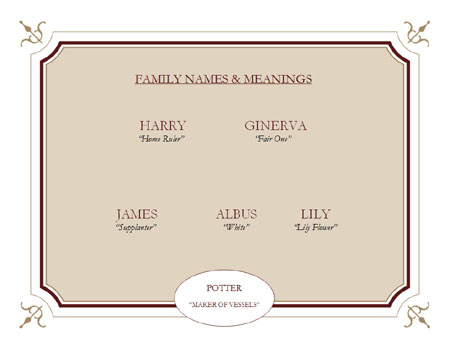
If you would like to download free family name templates, see our family name meaning charts.
Idea #5: Find out why a specific name was given
It is fun to find out the meanings of names, but what may be even more interesting (if you can get the information) is why a certain name was given.
Start with yourself and ask your parents, or family who might know, the reason why you were given the name you have. Research your family tree and try to find why your ancestors were given the names they have. Perhaps they were named after an uncle or an aunt, a grandpa or grandma. Sometimes one name was used in a family more than once: if a child died as an infant, the same name was often given to a later child.
Is there a particular story around why the name was given? Some can be quite funny, so check and see if you can find out why you and your family members were given certain names.
Idea #6: Map your surname
Look up your surname on Forebears or FamilySearch and see where in the world it’s most common today. Then compare that with where your ancestors actually lived. If your name is still concentrated in one county in England or one region of Germany, that’s a great clue for where to look next in your research.
So what’s in your name?
When an author names his or her book, a considerable amount of work and thought go into selecting a title that will be appropriate. Your name (and the names of your ancestors) may have been selected for no other reason than that the names sounded nice, but don’t be too disappointed, because it’s more important what you do with your name than why it was given or what it means. That’s your thought for the day.